
Submitted by Triinu
on
This blog post was written by our student ambassador Ana, who is a student of the semiotics programme at the University of Tartu.
Looking for an Ideal Activity to Fill Your Free Time? Studying and preparing for exams can certainly be a lot of work, so finding a great event to take your mind off a stressful period would be more than perfect. How about going to the theatre? Estonia boasts a rich and respected theatre culture, featuring diverse plays and artistic performances that consistently do not disappoint. Observing an intense plot, the interaction between characters, and a wide range of emotions and reactions from your seat is a truly unique and magnificent experience.
In this blog, I will write about my experiences of visiting two Estonian theatres and watching performances in both Estonian and Russian. I hope my blog will inspire students and other foreigners living in Estonia to visit Estonian theatres, as it is not only an amazing experience, but also a great way to practice and listen to the Estonian language.
As William Shakespeare once said: “All the world’s a stage, and all the men and women merely players.” So, join the stage and enjoy the plays.
Südalinnateater/ Vene Teater (Theatre in the Heart of the City / Russian Theatre)
Südalinnateater, also known as Vene Teater, is located right in the heart of Tallinn, hence the name. It is situated right across from Freedom Square, making it very easy to find. This theatre is mainly targeted at the Russian-speaking audience in Estonia, which explains its second name, Vene Teater (Russian Theatre). Most of the plays are performed in Russian, with Estonian subtitles.
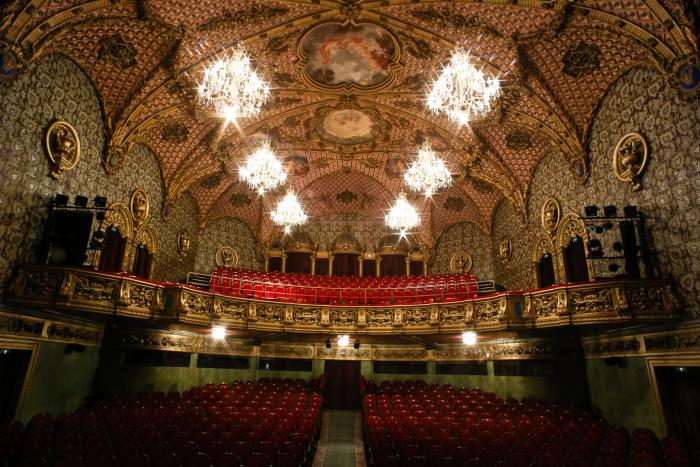
For all Russian-speaking students and foreigners, it is a great opportunity to enjoy a performance in their native language. I visited this theatre two months ago, and it was my first time attending a theatre performance in Estonia. I went to see the play “Teisipäev on lühike päev” (Tuesday Is a Short Day). It was directed by Dan Juritsov, and the play was performed in Russian, with Estonian subtitles displayed on the wall. The performance took place in the small hall (väike saal).
The plot revolved around a Russian mother who was deeply concerned about her son and his suspicious criminal activities, and how his life decisions affected her as well. The story perfectly portrays the struggles of the lower class and everything they have to do and endure in order to survive in a capitalistic world. It was a very powerful performance, with strong character dynamics, a well-designed stage and props, and above all, a clear and powerful message full of symbolism.
I really enjoyed the performance, and listening to the Russian language felt familiar and comforting, since my native language, Croatian, belongs to the same Slavic language family. Südalinnateater also has a beautiful and breathtaking interior, and I highly recommend everyone visit this amazing theatre—especially Russian-speaking students and those interested in learning and understanding the Russian language and culture.
Eesti Draamateater (Estonian Drama Theatre)
Another very important and popular Estonian theatre is Eesti Draamateater, one of the biggest theatres in Estonia. It is also located in the city centre, close to Südalinnateater and right next to Tallinn’s Old Town.
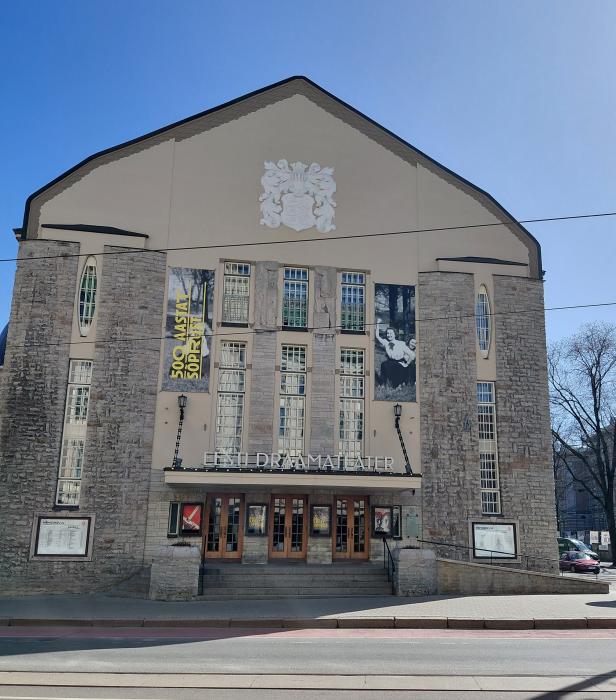
Estonian Drama Theatre hosts plays in the Estonian language, and many of them are adaptations of famous theatre works from around the world. Some plays also have English subtitles, which is great news for foreign theatre lovers. The theatre consists of a large hall with balconies and lounges, as well as a smaller hall. There is also a café where people can relax with coffee, tea, or a meal before or after the performance, or even during the intermission.
I visited the Estonian Drama Theatre to see the play “Arst” (Doctor). The play was about a head doctor who was ethically judged by a priest for performing a pregnancy termination (abortion) on a 14-year-old girl, who later died as a consequence of the procedure. The play criticizes the position of doctors within a religious and nationalistic context and explores the eternal boundary between being a doctor and being a human being.
It is an adaptation of the play “The Doctor” by English theatre director Robert Icke. This performance really touched me, and it helped me better understand the difficult decisions doctors have to make every day.
There are many other theatres in Tallinn, such as Theatrum, Tallinna Linnateater (Tallinn City Theatre), and Von Krahl. In Tartu, the most popular theatres are Vanemuine and Uus Teater (New Theatre). There are also many other theatres all over Estonia. For more information, you can visit this website.