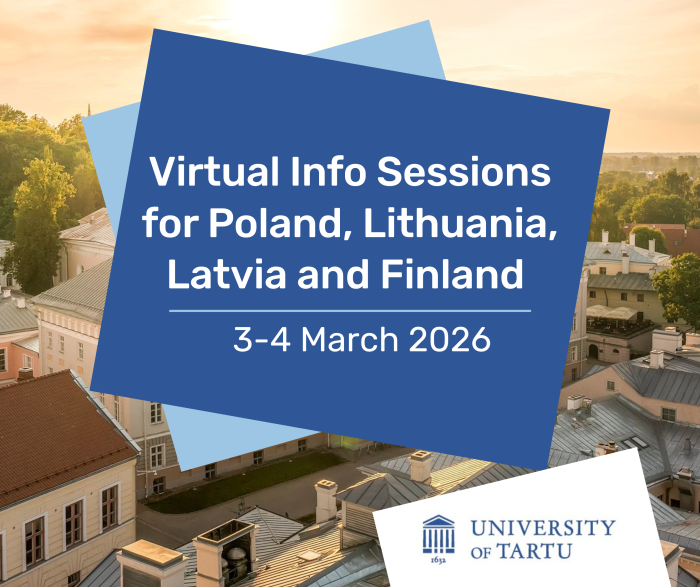
The University of Tartu invites prospective students from Poland, Finland, Latvia and Lithuania to join country-focused virtual info sessions taking place on 3–4 March 2026. These info sessions are tailored specifically for students from these regions and offer an opportunity to learn more about the university’s international degree programmes and student experience directly from university representatives and current students from these countries.
The virtual info sessions will provide an overview of studying at the University of Tartu, Estonia’s leading higher education institution. Participants will learn about the admission process, student life, and the university’s English-taught bachelor’s and master’s programmes. The session will also highlight what makes the University of Tartu a distinctive study destination in Northern Europe.
During the live Q&A, attendees will have the chance to ask questions directly from university representatives and gain practical insights into studying in Estonia.
Registration for the info sessions:
- 3 March at 18:00 (EET) Tarptautinės studijų programos Tartu universitete. Register here
- 3 March at 18:00 (CET) Międzynarodowe studia licencjackie na Uniwersytecie w Tartu. Register here
- 4 March at 18:00 (EET) Kansainväliset tutkinto-opinnot UniTartussa. Register here
- 4 March at 19:00 (EET) Starptautiskās Tartu Universitātes studiju programmas. Register here
International degree programmes for the 2026/27 academic year
Bachelor's programmes:
- Business Administration
- Medicine (6 years, integrated bachelor's and master's studies)
- Science and Technology
Master's programmes:
- Actuarial and Financial Engineering
- Bioengineering
- Clinical Nutrition
- Clinical Pharmacy
- Computer Science
- Creative Project Management
- Disinformation and Societal Resilience
- Educational Technology
- Entrepreneurship in Economic Policymaking
- European Languages and Cultures
- Estonian and Finno-Ugric Languages
- Excellence in Analytical Chemistry (Erasmus Mundus)
- Folkloristics and Applied Heritage Studies
- Geoinformatics for Urbanised Society
- Innovation in Bioengineering
- Innovation and Technology Management
- International Law and Human Rights
- International Relations and Regional Studies
- Materials Science and Technology
- Philosophy in Practice
- Politics and Governance in the Digital Age
- Quantitative Economics
- Robotics and Computer Engineering
- Semiotics
- Software Engineering